Alan Morton-Smith
Mindreign.com
05/10/2009
The challenges facing humanity were recently discussed in a slightly dilapidated building overlooking the East River in New York. The new session of the UN General Assembly — the organisation’s main forum for debate — kicked off with its usual array of eccentric speakers, charming traditions and rampant politicking. The main topics for debate during its sixty-fourth session included climate change; non-proliferation and disarmament, and the world financial and economic crisis and its impact on development. Heads of state flock here, to the premier forum for international diplomacy. There’s no other event that offers the same opportunity to participate in face-to-face discussion with the high-level actors of the world stage.
The UN itself is undergoing major changes, not least the currently under way $1.9 billion renovation of its headquarters on Manhattan. This will restore and update the 1950s buildings, built in an internationalist style, and greatly reduce their energy consumption. The Capital Master Plan, as it is known, is due to be completed by 2013, and involves all workers temporarily leaving the 39-story Secretariat tower. This is not before time, as the building systems have been running approximately 30 years longer than their expected lifecycle. Many of the parts and pieces for the mechanical and electrical systems cannot be bought anymore, so much like NASA, who has to source parts for the Space Shuttle from eBay, craftsmen in the basement shops of the UN have to adapt parts in order to keep the systems running.
Two leaders
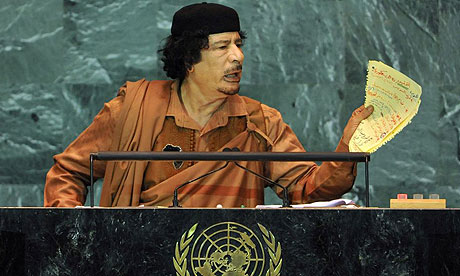
However, the main General Assembly chamber is still currently open for business, and over the course of the week no less than 118 heads of state and government spoke from the podium, along with dozens of ministers. At the very first session held in 1947, Oswaldo Aranha, then head of the Brazilian delegation to the UN, began a tradition that has remained to this day, whereby the first speaker is always a Brazilian. But it was the two speeches that followed which received by far the most coverage, each for rather different reasons. The individuals in question were President Barack Obama and Libyan leader Muammar Gaddafi, who were both giving their first addresses, after having been in power for forty weeks and forty years respectively. Things didn’t go quite according to plan when the latter spoke, when he proceeded to give a rambling speech that stretched for six times longer than his allotted time slot. As the New York Times noted: although a red warning light illuminates after the 15-minute time limit, United Nations officials said they could not remember anyone interrupting a head of state to explain that the allotted time had expired.
Gaddafi’s speech was impressive in the sheer variety of subjects covered, including questioning the assassinations of John F Kennedy and Martin Luther King, and pondering whether swine flu had been created in a government laboratory. He also denounced the Security Council — the UN’s most powerful body — describing it as the “terror council”, and demanded compensation for Africa to the tune of $77.7 trillion, for the resources and wealth that had been stolen in the past through colonialism. He was following in the fine tradition of theatrics in General Assembly speeches, encompassed by the likes of the President of Venezuela, Hugo Chávez, who in 2006 memorably compared President George W Bush to Satan: “The devil came here yesterday, and it smells of sulphur still.”
But to return to the present: President Obama’s speech also overran, and clocked in at 38 minutes. However, this was not nearly as contentious, due to him passionately asserting his country’s commitment to the UN. He went on to say that “we have paid our bills”, joined the Human Rights Council and fully embraced the Millennium Development Goals – an incredible shift from the outright hostility of the previous administration, whose stance was typified by the appointment of John Bolton as US ambassador to the United Nations. This is the individual who once said, “If the UN Secretariat building in New York lost ten storeys, it wouldn’t make a bit of difference.”
On the critical issue of climate change, Obama also distinguished himself from his predecessor, in stating that the danger posed by it could not be denied and nations’ responsibility to meet the challenge could not be deferred. Along with heads of state from over 100 countries, he attended the Secretary General’s “high level meeting” on the subject, with the intention of building momentum ahead of the World Summit on Climate Change that will take place in Copenhagen in December. Leaders of several small island nations warned that their ecosystems are already threatened by climate change effects, including rising sea levels and disappearing marine life.
The common good
The importance of the UN as a place where leaders and their representatives can gather in one spot, exchange views and negotiate cannot be understated. In recent years its reputation has been rather battered, with the alleged fraud in the oil-for-food programme in Iraq — in which some of the UN’s top officials were implicated, as well as the son of then-Secretary General Kofi Annan. But many of the problems nations are faced with today, including the global financial crisis, climate change, and the proliferation of nuclear weapons, can only be tackled through intense international co-operation. If anything, the powers of the UN need to be bolstered, and it certainly needs to be better funded, if it is to fulfil the lofty goals laid out in its Charter. The reforms that General Assembly president Ali Treki is pushing for, including bringing the Security Council into the 21st century, from middle of the 20th, where it currently stands, are to be welcomed. But the organisation’s fate rests with its 192 member nations, and the extent to which they are prepared to work together for the common good of mankind.
Leave a Reply