 Alan Morton-Smith
Mindreign.com
09/10/2009
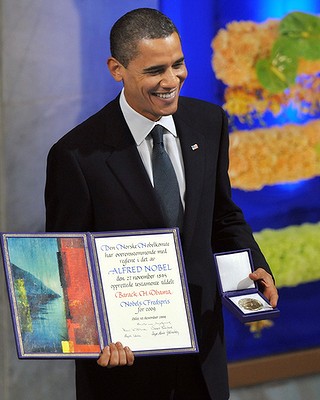
President Obama has won the Nobel Peace Prize, after having been in office for just nine months — a testament to the rapidly increasing pace of modern life. The Norwegian Nobel Committee hailed Obama’s “extraordinary efforts to strengthen international diplomacy and cooperation between peoples.” It’s traditional not to notify the winner beforehand, so The White House was informed at the same time as everyone else. Press secretary Robert Gibbs heard the news from reporters, and telephoned the White House early on Friday morning to pass along the news to his boss. He’ll receive a gold medal, a diploma and a cheque worth 10 million Swedish kronor ($1.42m, or €980,000) at a ceremony in Oslo City Hall on December 10, the date on which Alfred Nobel died.
Though he has done many admirable things, including trying to move the Middle East peace process forward; working to curtail the proliferation of nuclear weapons and so forth, it is arguably more than a tad premature to give him such a prestigious accolade. It’s also interesting to note that the nomination period ended eleven days into his presidency. In their defence, Thorbjørn Jagland, chair of the Committee, noted in a press conference that Willy Brandt, the Chancellor of West Germany also received the award whilst in office. He pursued the important policy of Ostpolitik, aimed at improving relations with the communist bloc countries. Yet he had been in power for two years before being awarded the prize.
Zimbabwean Prime Minister Morgan Tsvangarai had been among the favorites to win this year, from a record field of 205 candidates, including a Chinese dissident and an Afghan human rights activist. He has endured a great deal during his ten-year tenure as leader of the Movement for Democratic Change, including a ferocious police attack on the basis that he had been taking part in an “illegal” prayer meeting. That he managed to create a functioning coalition government with Zanu-PF in the first place is an achievement in itself — the first step in getting the country back on its feet after a total economic collapse. Some commentators have also suggested that if Tsvangirai had won the prize it could have helped strengthen his hand in dealing with President Robert Mugabe.
But this is not to downplay or disparage President Obama’s achievements, who was “humbled to be selected by the committee”. As the Associated Press points out, the prize is awarded to encourage those who receive it to see the effort through, sometimes at critical moments, not solely after they have proven successful — a sentiment which Mr Jagland echoed in the press conference. Certainly, the shift of world opinion towards the US during his time in office has been immense, and this has been down to the work of his administration and the policies which he has set in motion. Fully engaging with international institutions is a distinct shift away from the Presidency of George W Bush, who had other ideas about how best to deal with other countries.
But although his desire may be present to tackle issues such as climate change, his ability to tackle them is dependent on getting the support of Congress, who will draft and pass the legislation. In the case of Iran, negotiations have at least started, but given that President Mahmoud Ahmadinejad is still at the helm despite the popular uprising earlier in the year, there is no way of telling how successful these will be. Similarly a question mark also hangs over the prospects for peace between Israel and the Palestinians, given that hardline Israeli Prime Minister Binyamin Netanyahu is in charge.
Hopefully in the years to come, history will confirm that President Obama was a great statesman. One who successfully pursued policies to bring about a more peaceful world, complete with stronger international institutions. But for the time being, he sits uneasily in a pantheon of past Nobel laureates that include the likes of Mother Teresa and Desmond Tutu.
Leave a Reply