Alan Morton-Smith
Mindreign.com
25/09/2009
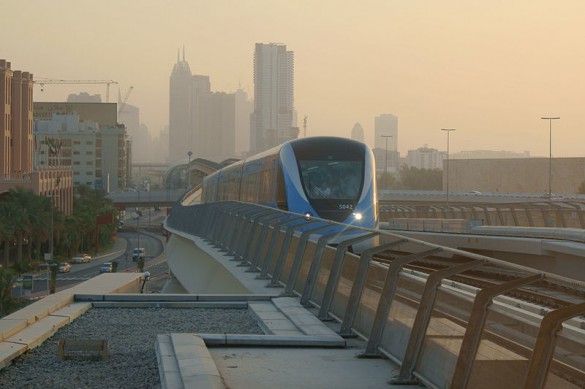
At 9:09:09 PM on September 9, 2009 Dubai achieved an impressive feat of engineering, by launching the world’s longest automated driverless rail system. Built in just four years by a Japanese consortium, the Red line is 52km long (comparable in length to the Northern line on the London Underground), and possesses the world’s biggest underground metro station. Dubai’s Roads and Transport Authority (RTA) expects 318km of metro lines to be in operation by 2020, which is just shy of the entire length of the New York City Subway.
However, all is not well in the state, which is one of the seven members of the United Arab Emirates (UAE). It has been hit by one of the steepest fall in property prices worldwide — a 47% decline in a year, according to Knight Frank’s Global House Price Index — as well as having been battered by the global financial crisis. As a result, its economic boom came to an abrupt end in 2008 after several years of windfall oil revenue. According to figures released by Fitch Ratings on September 24, the Dubai Government’s debt will have tripled from last year, to reach $30 billion by the end of 2009. This is nearly 40% of GDP, and has resulted in firm downgrading the ratings of seven banks, including the country’s largest lender by assets, and the largest bank by market value. Although it is the stated intention of the federal UAE government to support financial institutions, the ratings agency said that their ability to do so has deteriorated. In addition, Fitch has placed the country’s largest telecoms firm Etisalat on watch, with a view to potentially downgrading it as well.
Prestige projects
However, these short-term financial difficulties aren’t putting the brakes on the numerous prestige projects which have been announced in the UAE in recent years. Take Al Maktoum International Airport, for example, which is currently under construction. With no less than six parallel runways, a cargo capacity treble that of Memphis International Airport (today’s largest cargo hub) and 100,000 parking spaces, it’s a project on a staggering scale. This in turn is merely a constituent part of a complex which will eventually cover an area of twice that of Hong Kong Island, and will be home to 750,000 people. It’s all part of the emirate’s strategy to diversify its economy and wean itself off the oil and gas sector, which provides around a third of the UAE’s Gross National Product. The aim is to transform itself into a regional headquarters for banking, technology, media, shipping and aviation. Not that they need to hurry — the UAE has proven oil reserves which, at the current rate of extraction (2.5 million barrels a day) will last for at least another 150 years.
Dubai in particular has been building on past successful ventures, including the Jebel Ali Port, built in 1979 and the biggest such facility in the Middle East. The country is now the third most important re-export centre in the world, behind Hong Kong and Singapore. There was a significant amount of controversy in 2006 when the owner of Jebel Ali Port, Dubai Ports World, purchased the British firm P&O — who at the time were the fourth largest ports operator in the world. This opposition arose because P&O had port management businesses in six major US seaports, and various American political figures argued that the takeover would compromise US port security. But given that the UAE is a long-standing ally of the United States, this seems very unlikely indeed. However, Dubai Ports World eventually sold P&O’s American operations to American International Group’s asset management division for an undisclosed sum. AIG was subsequently one of the major financial institutions which had to be bailed out by the US federal government.
It can certainly be argued against the above xenophobic sentiment that the UAE is one of the most liberal countries in the Gulf. But this is still far removed from Western norms — for example, there are regulations banning things such as kissing in public and wearing skirts above the knee. According to the United Nations High Commissioner for Refugees, the constitution of the UAE provides for freedom of speech and of the press, but in practice, the government uses its judicial and executive powers to restrict those rights. Journalists regularly suffer from several forms of intimidation and harassment. Given the high-profile attempts to lure international media outlets to Dubai, as well as the focus on promoting itself as a tourism hub, clashes between traditional sensibilities and a modern outlook can only increase.
Post credit-crunch
Realistically, Dubai really has nothing to worry about, despite what a credit rating agency may say. The federal United Arab Emirates government is buying Dubai’s bonds and is still aiming for a nationwide growth rate of 3% for 2009. Once the credit crunch fully subsides and the global economy emerges from recession, it will most likely be a case of ‘business as usual’. Some of the more interesting developments will come from how the country squares its stated desire to become a major trade and tourism destination with the conservative values it espouses. The native population is already hugely outnumbered by foreign workers, with only 15-20% of residents being UAE citizens. According to a projection by Dr Abdul Khaleq Abdullah, Professor of Political Science at the Emirates University, this percentage will reach 10% by 2015, and 0% by 2025, which would be unprecedented. What would happen in a country with such a demographic make-up? As long as it’s good for business, the country’s rulers are unlikely to object.
Leave a Reply